Happy Father’s Day

.o0o.
Persistent Air Conditioning problems
On June 9, a concerned Aquarius unit owner submitted a letter to the Board of Directors and Management regarding persistently elevated humidity and temperature levels in the North Tower hallways. aquariusuno.com posted this letter from Mr. Chase. You can see it here.
On June 17, Aquarius Manager Maria Rentas responded, stating that an inspection of the air-conditioning system had been completed and that all equipment was operating properly.
However, current conditions suggest otherwise. Recent measurements continue to show elevated humidity levels comparable to those previously reported, directly contradicting the conclusion that the system is functioning as intended. Record of the humidity in the hallway is 71.4% on June 9 and 68.0% on June 19, 2026 well above to the maximum recommended.

June 9, 2026 Humidity 71.4% Temperature 76.6F Aquarius North Tower Hallway
Humidity levels exceeding 50% in enclosed common areas such as hallways are widely recognized as problematic. Excess moisture creates conditions conducive to mold and mildew growth, may negatively affect residents’ health and comfort, and can contribute to avoidable deterioration of building materials and infrastructure.

June 19, 2026 Humidity 68.0% Temperature 76.6F Aquarius North Tower Hallway
Given the continued presence of these conditions, it is concerning that no effective corrective action appears to have been taken to address the issue. The Board and Management should promptly investigate the cause of the excessive humidity and implement appropriate remedial measures to protect the health, safety, and property interests of all residents.
Here the communications from Arkady Chase, Ph5 and Maria Rentas, Aquarius Manager regarding the matter.
♦♦♦♦♦ From Arkady Chase in response to Maria Rentas June 17, 2026, 8:47PM
Subject: Continued High Humidity in Hallways – Additional Corrective Action Required
Dear Ms. Rentas,
Thank you for your update regarding the recent review of the North and South Tower hallway HVAC systems.
However, despite the inspection and fuse replacement, the humidity levels in the hallways remain unacceptably high. Residents continue to experience warm, damp air in the common corridors, which indicates that the system is not maintaining proper dehumidification, even if the equipment is technically “operational.”
As you know, maintaining safe and comfortable common areas is a core obligation of the Association. Elevated humidity is not a weather‑related inconvenience—it is a building systems issue that can lead to:
In addition to the HVAC concerns, we must also note that the opening in the hallway ceiling near PH6N remains unsealed (see attached), exposing the corridor to outside air and moisture. This condition directly contributes to the high humidity levels and must be addressed immediately. Leaving the ceiling open to the elements undermines the operation of the hallway HVAC system and poses additional risks of water intrusion and structural deterioration.
Accordingly, we respectfully request:
We appreciate the Association’s attention to this matter and look forward to a concrete plan to restore proper environmental conditions in the common areas.
Sincerely,
Arkady Chase
PH5N
♦♦♦♦♦ From: FirstService Residential [mailto:Communications@mc.fsresidential.com]
Sent: Wednesday, June 17, 2026 5:26 PM
To: arkady.chase@gmail.com
Subject: North & South Tower Hallway HVAC Update
Dear Residents,
The North Tower hallway HVAC system recently underwent a comprehensive review. During the review, two fuses affected by recent power surges were identified and replaced. The HVAC equipment itself did not experience a mechanical failure and remains operational. The system is currently functioning as designed.
As part of this review, the South Tower hallway HVAC system was also inspected.
Please keep in mind that the recent increase in outdoor temperatures places additional demand on the building’s cooling systems. In response to current weather conditions, adjustments have been made to the system to help accommodate the increased cooling load.
Please keep unit windows, sliding glass doors, balcony doors, and entry doors closed during periods of elevated temperatures. This helps prevent warm air from entering the building and supports the HVAC system’s ability to maintain comfortable temperatures throughout the common areas.
Residents are also encouraged to operate and maintain their individual air-conditioning systems appropriately during periods of elevated temperatures, as conditions within individual units can affect overall building comfort. The North and South Tower hallways HVAC system continues to be monitored to ensure it is operating as intended.
My Regards,
Maria Rentas, Property Manager
Aquarius Condominium Association, Inc.
2751 South Ocean Drive | Hollywood, FL 33019
Direct: 954.921.7924 Fax: 954.921.9768
Email: maria.rentas@fsresidential.com
Website | Facebook | LinkedIn | YouTube
.o0o.

Aquarius celebrates 4th of July
Celebrate America’s 250th birthday with your neighbors on Saturday, July 4th at 4:00 PM in the Green Room. Enjoy community, conversation, and a little patriotic fun—plus barbecue and traditional fare.

The tickets are: $20 for adults and $10 for kids under 10 years.
Emma 646-220-1150 and
Taisa 347-524-6978 are accepting the reservations and providing the wrist bands.
Sale of tickets ends First of July.

.o0o.
As the day of Saint Anthony dawns upon us…
.o0o.
Hurricane Season PreparednessAll residents are invited! The Hollywood Beach Civic Association is hosting an important community meeting. Light refreshments will be provided.

District 1 Commissioner Caryl Shuham, the Hollywood Beach Civic Assn, the Hollywood Lakes Civic Assn and the Hollywood North Beach Civic Assn will host a Hurricane Preparedness meeting on Thursday, June 11th at 7pm at the Hollywood Beach Community Center.
Don’t miss this important meeting and please tell your neighbors.


.o0o.
Silencing critics can come at a steep cost.Efforts to silence critics frequently backfire, imposing costs far greater than anticipated. Consider these two cases
“”The state of Florida has to pay $485,000 to a biologist from a state agency who was fired last year for criticizing Charlie Kirk’s political views on social media. Brittney Brown sued the state, arguing her free speech rights were violated when Florida’s Fish and Wildlife Conservation Commission fired her for reposting an Instagram meme about Kirk’s opposition to gun control after the conservative activist was assassinated in September. U.S. District Judge Mark Walker said that Brown’s post was protected speech under the First Amendment.
The case was seen as a potential bellwether for how federal courts might react to other lawsuits filed by employees who lost their jobs over Kirk-related speech.
Another lawsuit was settled for $225,000 this week between Ball State University in Indiana and its former director of health promotion and advocacy, who was fired for a Facebook post in which she said Kirk’s killing was “a tragedy,” but “a reflection of the violence, fear, and hatred he sowed.””
Congress shall make no law respecting an establishment of religion, or prohibiting the free exercise thereof; or abridging the freedom of speech, or of the press; or the right of the people peaceably to assemble, and to petition the Government for a redress of grievances.

.o0o.
Urgent Notice – Persistently Unsafe Humidity Levels in Common Hallways (71.4% RH Today June 9th., 2026This letter serves as a formal and repeated notice regarding the ongoing excessive humidity levels in the North Tower common hallways. Despite multiple prior notifications from me over an extended period, the condition remains unresolved and continues to pose a serious risk.
Today’s reading, taken with a Protmex YT606 Digital Temperature Humidity Meter, measured 76.6°F and 71.4% Relative Humidity. This is consistent with the prolonged periods of elevated humidity previously reported, including numerous readings well above the 60% threshold recognized by EPA and ASHRAE as unsafe.

Sustained humidity at these levels is known to promote mold growth, damage drywall, flooring, and building materials, and contribute to deterioration of HVAC components. It also presents potential health risks, particularly for residents with respiratory sensitivities, allergies, or compromised immune systems.
Because the hallways are common elements under the Association’s responsibility, the continued failure to maintain safe environmental conditions exposes the Association to avoidable property damage, potential health impacts, and significant insurance complications should mold or moisture‑related damage occur.
Unless management provides an immediate, written, and actionable plan to correct this condition, I will proceed with notifying the Association’s insurance carrier. I am also prepared to seek the assistance of legal counsel to ensure that this matter is addressed promptly and in accordance with the Association’s obligations.
Please provide a written response detailing the corrective measures being taken and the timeline for restoring hallway humidity to safe and compliant levels.
Thank you for your immediate attention.
Sincerely,
Arkady Chase,
Aquarius Condominium PH5N
.o0o.
ALERT Should we have Public Land for Private Use? Hollywood Beach Community Center under threat.
The Hollywood Beach Civic Association issues an important community alert.
The Hollywood Beach Cultural and Community Center and the Hollywood Branch Library are currently under consideration for redevelopment that would allocate this public land to a private residential skyscraper project. This proposal would convert long‑standing public space into private use and would require changes to existing city statutes.
The Civic Association urges all concerned residents to make their voices heard and share their views on this critical issue.
It is possible to halt the progress of this initiative: “Essentially, (action by residents) could then put a stop to any further action to HALT the repurposing and/or sale of the 1301 South Ocean Dr. property and changes to our beach community center, as the property will be in the hands of developers through the Live Local Law. ” says HBCA.
And they add “Whichever decision you believe is correct, can be shared in support or in opposition, and is entirely up to you. However, The majority of HBCA remains opposed to and clearly NOT in favor of any action to sell Taxpayer owned, public land and has remained in opposition for many years. We have been rather in strong favor of a referendum, a VOTE of the people!!!”
The HBCA and many Hollywood residents are working to prevent the transfer of public land—land actively used and valued by the community—into private hands for the benefit of developers.
HBCA urges you to:
1. Call and Write to the Commissioners and the Mayor stating your view and …
Mayor of Hollywood, Florida, is Josh Levy. You can contact him via email at jlevy@hollywoodfl.org. Telephone: (954) 921-3321
| Shuham, Caryl S. | Commissioner, District 1 | 954.921.3321 | |
| Hernandez, Peter | Commissioner, District 2 | 954.921.3321 | |
| Callari, Traci L. | Commissioner, District 3 | 954.921.3321 | |
| Gruber, Adam | Commissioner District 4 | 954.921.3321 | |
| Biederman, Kevin D. | Commissioner, District 5 | 954.921.3321 | |
| Quintana, Idelma | Commissioner, District 6 | 954.921.3321 |
2.If you agree with HBCA state:
“I strongly oppose any actions taken by this Commission regarding the 1301 project and any related issues such as utilization of the Live Local Law and urge you each to DELAY any action, or votes, until after Election Day, November 3, 2026 has ended and all votes confirmed.”
If this decision gets a final approval it will be as HBCA affirms: “it will set a precedent for developers to build without regard to restrictions that are currently in place, along our entire beach and throughout our city as well! Affordable housing has it’s value but this action does NOT adequately provide it. This instead, is a subsidy for developers.”
Recommended Contacts to Notify Often!
Details of the Proposal to alienated public land occupied the the Hollywood Beach Community Center

.o0o.
INVESTIGATIVE REPORT 2
Dr. Philippe Cooper, 1603N
Hollywood, Florida • May 3, 2026 • Special Investigation | Aquarius Condominium Association, 2751 S Ocean Drive, Hollywood, FL 33019
Under Threat of Regulatory Action After Three-Week Stonewalling Campaign — But What They Produced Is Barely Worth the Fight
On April 13, 2026, unit owners at Aquarius Condominium Association formally requested copies of the Association’s water intrusion emergency response procedures — the operational protocols staff are required to follow when water is flooding a unit. The Association twice refused, claiming the documents were “internal operational procedures” outside the scope of Florida’s condominium records statute, §718.111(12). Legal analysts described that position as plainly wrong. The Association’s ten-day statutory compliance window elapsed April 25, 2026, triggering a presumption of willful non-compliance under Florida law. When the Association failed to comply, residents followed through: on May 1, 2026, they filed a formal complaint with the Department of Business and Professional Regulation, the state agency that oversees Florida condominium associations.
This report covers what happened next — and what was produced.
HOLLYWOOD, Fla. — Faced with a firm deadline, a documented record of statutory non-compliance, and a formal complaint already filed with the Department of Business and Professional Regulation, the Board of Directors and management of Aquarius Condominium Association reversed course on May 3, 2026. After three weeks of refusal — including two denial letters asserting a legal position that Florida attorneys characterized as plainly unsupportable — Association Manager Maria Rentas transmitted the requested water intrusion operational procedures to the unit owners who had demanded them.
It was the deadline residents had set. It was also the day they made good on their commitment, filing a formal complaint with the Department of Business and Professional Regulation under §718.1255. And it was, by any measure, a capitulation — one that arrived too late to prevent the regulatory record from being opened.
Then residents read what had been produced.
The production arrived without explanation. There was no cover letter acknowledging the delay. No retraction of the April 27 denial letter, which had characterized the requested documents as outside the statute’s reach. No retraction of the April 28 follow-up, in which the Association doubled down on that position word for word after receiving a detailed statutory rebuttal. No statement from the Board. No acknowledgment that the ten-day compliance deadline had elapsed eight days earlier.
The documents simply appeared.
There was no retraction, no apology, no acknowledgment that the Association had spent three weeks insisting it had no legal obligation to share documents it has now shared.
Sources close to the matter characterized the timing as unmistakable. The Association did not produce the documents because it concluded its legal position was wrong. It produced them because a regulatory complaint was now on file with the state, and the pressure had become untenable.
The Association’s eventual production does not reach back and cure a statutory violation that had already occurred.
Florida Statute §718.111(12)(b) is unambiguous: failure to produce requested official records within ten working days of a written request creates a rebuttable presumption that the association “willfully failed to comply.” The original request was submitted April 13, 2026. The ten-day window closed April 25 — two days before the Association even issued its first denial letter, and eight days before it finally produced the records.
Under Florida law, that presumption is not dissolved by subsequent compliance. The violation crystallized on April 25. The Association’s decision to produce the records on May 3, while welcome, does not retroactively satisfy an obligation that had already gone unsatisfied for nineteen days from the date of the original request.
The violation crystallized on April 25. Nineteen days elapsed between the original request and production. Florida law does not erase that interval simply because compliance eventually arrived.
Florida Statute §718.111(12) provides unit owners with statutory and actual damages for any period of willful non-compliance. Attorney’s fees and costs are also recoverable. Whether residents choose to pursue those remedies is a decision for them and their counsel — but the legal predicate exists, and the production of the documents on the day a regulatory complaint was filed does not eliminate it.
Having fought for three weeks to withhold it, the Association produced a three-page bullet-point checklist. That is not an editorial characterization. It is a description of the document.
The Aquarius Condominium Association Water Intrusion Response Standard Operating Procedure runs to three pages. It identifies who is supposed to show up (Security, Maintenance, Housekeeping), notes that blowers should be kept running, and specifies that an incident report should be prepared. It contains no severity classification system. It contains no response time requirements. It contains no moisture reading protocol — no baseline measurements, no drying standards, no criteria for determining when a unit is actually dry. It contains no contractor call lists. It contains no emergency vendor contacts. It contains no notification requirements specifying when affected unit owners must be informed, by whom, or within what timeframe. It contains no insurance reporting procedures. It contains no escalation thresholds defining when professional remediation is required versus when staff extraction is sufficient. And it contains no reference whatsoever to the location of domestic water supply shutoff valves — neither the shutoff points for individual units nor the riser or floor isolation valves serving multiple units simultaneously. In a building where stopping water flow within the first minutes of an event is the single most consequential action available to a first responder, the absence of a shutoff valve location guide is not a minor omission. It is the omission that makes every other procedure in the document harder to execute.
In a building where water intrusion can migrate across multiple floors within minutes, destroy flooring, walls, and personal property, and create conditions for toxic mold growth within 24 to 48 hours, this is the document the Association spent three weeks protecting from its own residents.
In a building where water intrusion can migrate across multiple floors within minutes and create mold conditions within 48 hours, this is the document the Association spent three weeks protecting from its own residents.
The original records request was explicit. Residents asked not just for policies, but for “contractor call lists, emergency contacts, and decision frameworks.” The produced document contains none of those things. Whether those materials exist in some other form — and were simply not produced — is a question that has not been answered.
The Disclaimer. The most remarkable feature of the produced document is not what it contains. It is what it says about itself.
The final page of the SOP carries a lengthy disclaimer paragraph. Its operative language is worth reading carefully:
“The steps described in this SOP are aspirational and may be reasonably modified, omitted, or performed in a different order or manner in the exercise of staff judgment… and any such deviation shall not, in and of itself, constitute evidence of negligence, breach of duty, or wrongdoing by the Association…”
Read that again. The Association produced a water intrusion response policy — under legal compulsion, after three weeks of insisting it had no obligation to do so — that describes its own procedures as “aspirational” and preemptively declares that failing to follow them is not evidence of wrongdoing.
This is not standard disclaimer language. Standard SOP disclaimers acknowledge that real-world conditions may require judgment calls in emergencies. This disclaimer goes considerably further: it expressly disavows liability for “non-implementation” of the SOP itself, and states that deviations “shall not constitute evidence of negligence.” In plain English, the Association has produced a policy manual that simultaneously argues it is not a policy manual.
The Association produced a water intrusion response policy that describes its own procedures as ‘aspirational’ and declares in advance that failing to follow them is not evidence of wrongdoing. It is a document specifically engineered to be useless in litigation.
The practical effect is transparent. If a resident’s unit suffers water damage because staff failed to follow the procedures in this SOP — failed to deploy extraction equipment, failed to monitor drying, failed to notify the owner — the Association has pre-positioned itself to argue that the SOP creates no enforceable standard. It is a document specifically engineered to be useless in the litigation it was presumably written to forestall.
Whether that disclaimer is enforceable under Florida law is a separate question, and one for legal counsel. What is not a separate question is the posture it reflects. An association genuinely committed to protecting its residents from water damage does not write a policy and then append language disclaiming the policy. It writes a policy and follows it.
The Confidentiality Legend. The SOP bears a header on its face reading: “Confidential – Internal Use Only – Not for Distribution or Publication.” This is the same document the Association insisted was not subject to owner inspection under §718.111(12) — the same statute that designates all written records related to the operation of the association as official records open to owner review.
Now that the document has been lawfully produced pursuant to a valid statutory records request, that confidentiality legend has no legal force as to the requesting owners. Florida’s condominium records statute does not permit associations to place official records beyond the reach of owner inspection by stamping them confidential. The Legislature’s catch-all provision — §718.111(12)(a)21 — does not contain a confidentiality exception. The Association’s own legend, placed on a document it was required by law to produce, illustrates precisely the institutional reflex that Florida’s records statute was designed to override.
The production of the records is a development. It is not a resolution. Four issues remain squarely open.
The statutory violation stands. As detailed above, the presumption of willful non-compliance attached April 25 and is not erased by the May 3 production. Statutory damages, actual damages, attorney’s fees, and costs remain available to residents for the period of non-compliance. The question is whether to pursue them.
The adequacy of the produced policy is itself now a live issue. A three-page checklist with no severity classifications, no response timelines, no moisture standards, no shutoff valve locations, no contractor contacts, and a built-in disclaimer of its own enforceability raises a question distinct from whether records were produced: is the Association’s water intrusion response program substantively adequate to protect residents and their property? That question was implicit in the original records request. The produced document makes it explicit.
The Association has not explained itself. Two letters were sent asserting a legal position that has now been effectively abandoned. The Board has not addressed its unit owners. Management has offered no accounting. Residents are entitled to understand how the Association arrived at a legal stance it ultimately could not maintain — and what role, if any, the Board played in authorizing it.
Personal liability exposure has not been addressed. Florida Statute §617.0834 exposes directors and officers to personal monetary liability where their conduct in a records dispute is found to be reckless or in bad faith. An association that refuses official records twice — after receiving a detailed statutory rebuttal — and then produces those same records only after a regulatory complaint has been filed with the state presents a set of facts that warrants careful review under that standard.
This outcome is a case study in how Florida’s condominium records statute functions — and in its limits.
The statute’s design is deliberate: unit owners have a right of access to official records; associations have ten days to comply; non-compliance creates a presumption of willfulness; and the Division of Florida Condominiums provides an accessible enforcement mechanism that does not require litigation. The Legislature built that framework specifically to protect owners who lack the resources or appetite for a courtroom fight.
What the statute cannot do is guarantee that what an association produces is worth having. Residents fought for three weeks — preparing formal requests, researching the statute, drafting detailed rebuttal letters, building toward a regulatory filing — and what they received is a document whose own authors describe its procedures as aspirational and whose practical value in a real flood emergency is, at best, unclear.
Residents fought for three weeks and received a document whose own authors describe its procedures as ‘aspirational.’ The fight was worth having. The document was not worth protecting.
That observation does not diminish what residents accomplished. Forcing compliance with Florida’s records statute matters — not only for the document obtained, but for the institutional signal it sends. Associations that resist transparent records requests calculate that the cost of resistance is lower than the cost of disclosure. When residents demonstrate that they will pursue available remedies to the end, that calculation changes.
But the adequacy of what was disclosed is now the next question. A policy that disclaims being a policy, produced by an association that spent three weeks fighting to conceal it, is not a conclusion. It is an invitation to look harder.
Residents are reviewing the produced SOP and assessing whether the procedures it describes — to the extent they constitute procedures at all — reflect how the Association actually operates when water is flooding a unit at two in the morning.
The question of remedies for the period of non-compliance is under active consideration.
The question of whether the produced policy is substantively adequate to meet the Association’s obligations to its residents under Florida §718 and its own Declaration remains open — and will receive further scrutiny.
The question of whether additional responsive records — contractor call lists, emergency vendor contacts, escalation protocols — exist and were not produced is also under review.
This publication will continue to report on governance, transparency, and statutory compliance at Aquarius Condominium Association.
This report is based on official correspondence, the Association’s produced SOP, statutory analysis, and information provided by sources familiar with the matter. All statutory citations refer to Florida Statutes as currently in effect. Readers seeking background on the original records dispute are referred to the prior investigative report: “Locked Out of the Records Room: How Aquarius Condominium’s Board and Management Are Stonewalling Residents and Defying Florida Law,” published April 28, 2026.
— END OF REPORT —
.o0o.
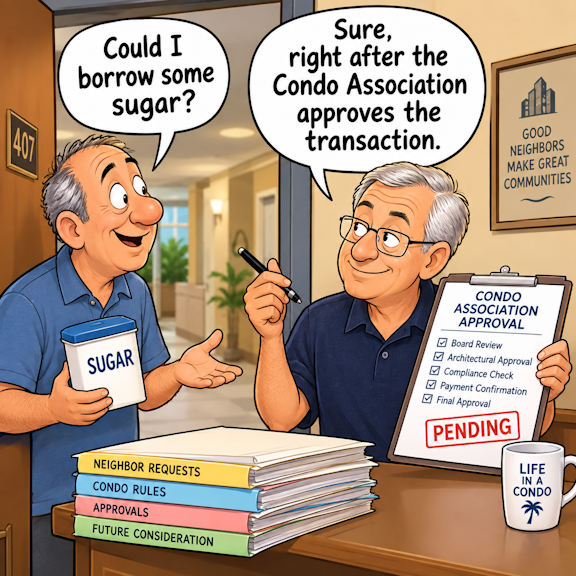
Laughing Matter:

.o0o.
INVESTIGATIVE REPORTHollywood, Florida • April 28, 2026
Special Investigation | Aquarius Condominium Association, 2751 S Ocean Drive, Hollywood, FL 33019
Dr. Philippe Cooper, 1603N
HOLLYWOOD, Fla. — When unit owners at Aquarius Condominium formally requested copies of their Association’s water leak emergency procedures, they expected a routine response. What they received instead was a flat refusal — and a legal argument that Florida attorneys say is plainly wrong.
The dispute, now escalating toward regulatory action and potential litigation, raises uncomfortable questions about transparency, accountability, and whether the Board of Directors and management at Aquarius Condominium are operating within the bounds of Florida law — or well outside them.
On April 13, 2026, unit owners submitted a formal written request to Association Manager Maria Rentas for the Association’s after-hours operational procedures governing responses to water leaks — the protocols, contractor call lists, emergency contacts, and decision frameworks that staff and management are supposed to follow when water is flooding a resident’s unit in the middle of the night.
The request was reasonable. Water intrusion is among the most damaging and frequently recurring crises in a high-rise coastal condominium. Residents have a legitimate interest in knowing whether their Association has a plan — and whether that plan is actually being followed.
The Association’s April 27 response, signed by Ms. Rentas, denied the request outright. Her stated reason: the documents are “internal operational procedures” that fall outside the scope of Florida Statute §718.111 and therefore are “not subject to owner inspection.”
Legal analysts who reviewed the denial letter described the position as legally unsupportable.
“The Legislature enacted [§718.111(12)(a)21] precisely to prevent associations from shielding operational documents by labeling them ‘internal.'”
Florida Statute §718.111(12) is one of the most expansive owner-access provisions in any state’s condominium law. It requires associations to maintain and produce a broad catalog of official records upon written request — and it contains a deliberate, explicitly worded catch-all provision.
What the Association’s denial conspicuously ignores is the statutory architecture of §718.111(12)(a) itself. The Legislature did not create a vague list of documents that might, under some circumstances, be made available to owners. It created an exhaustive, enumerated roster of “official records” — using that exact term — and then mandated that every item on that list be maintained by the association and open to owner inspection.
Every document category listed under §718.111(12)(a) — items 1 through 21 — carries the same legal designation: official records. That is not a courtesy title. It is a statutory classification that triggers specific maintenance, retention, and access obligations. The Association cannot strip a document of its “official record” status simply by deciding, after the fact, to call it “internal.”
To illustrate the breadth of the Legislature’s intent, §718.111(12)(a) explicitly designates as official records, among others:
Plans, permits, warranties, and other items provided by the developer (item 2);
All contracts for work to be performed (item 6);
Financial and accounting records (item 7);
Ballots, sign-in sheets, and voting proxies (item 15); and
All other written records related to the operation of the association (item 21).
Item 21 is the statute’s deliberate catch-all — and it exists for precisely this situation. The Legislature understood that associations might attempt to shield inconvenient operational documents by categorizing them as something other than “official records.” Item 21 forecloses that maneuver. If a written document exists and relates to how the association operates, it is an official record. Full stop.
Written procedures governing emergency response to water leaks — a core operational function of any residential high-rise — fall squarely within item 21’s language. There is no credible legal basis for the Association’s claim that such documents are exempt.
Residents pushing back on the denial made exactly this argument in a formal rebuttal letter dated April 28, 2026: “Your characterization of these documents as outside the statute’s reach is not a good-faith legal interpretation; it is a misreading that Florida law does not permit.”
Presented with that detailed statutory rebuttal — and placed on formal notice of the legal consequences of continued refusal — the Association had an opportunity to reconsider its position. It did not take it.
On April 28, 2026, the Association issued a second response. In its entirety, the relevant portion reads:
“The Association maintains its position that internal operational procedures, including emergency response protocols and related materials, are not official records subject to inspection under the statute.”
That is the entirety of the Association’s legal argument: a restatement of the same position, word for word, with no engagement whatsoever with the statutory text, no response to the catch-all language of item 21, and no acknowledgment that the ten-day compliance deadline had already expired.
The response is notable for what it does not do. It does not cite any case law supporting an “internal” exemption — because none exists. It does not identify any provision of §718.111 that carves out operational procedures — because the statute contains no such carve-out. It does not offer any alternative legal basis for the refusal. It simply repeats the original, legally defective denial and declares the matter closed.
For residents and their legal counsel, the Association’s doubling-down is significant. Under Florida law, the willfulness of non-compliance is a factor in assessing damages. An association that refuses records once may claim confusion or inadvertence. An association that refuses twice — after receiving a detailed statutory rebuttal laying out the exact legal basis for the request — has considerably less room to claim good faith.
The situation is not merely a legal disagreement — it is an active statutory violation.
Florida Statute §718.111(12)(b) states that failure to produce requested records within ten working days of a written request creates a rebuttable presumption that the association “willfully failed to comply.” The original request was submitted April 13, 2026. Ten working days elapsed on approximately April 25, 2026 — two days before the Association even issued its denial letter.
In other words: the Association did not just refuse to produce the records. Under Florida law, it is now presumed to have willfully refused to produce them.
The consequences of continued refusal are not abstract. Florida law provides unit owners with a powerful enforcement toolkit:
Statutory and actual damages are available to any owner denied access to official records under §718.111(12).
Destruction of or refusal to allow inspection of official records may constitute obstruction under Chapter 843, Florida Statutes.
Directors and officers can face personal monetary liability under §617.0834 where their conduct is reckless or in bad faith.
The residents’ rebuttal letter made the consequences explicit, warning that absent compliance by May 3, 2026, they will file a petition for alternative dispute resolution with the Division of Florida Condominiums, Timeshares, and Mobile Homes under §718.1255, and pursue all available statutory damages, attorney’s fees, and costs.
Sources familiar with the Association’s recent history say this episode does not exist in isolation. Previous disputes have involved questions about the consistency of the Association’s governing documents, enforcement of maintenance obligations, and the relationship between the 1973 Declaration and more recent restated governing instruments.
The refusal to produce operational procedures — documents that directly affect the safety of residents and the protection of their property — fits a pattern in which management and the Board appear to treat transparency as optional rather than obligatory.
Florida’s condominium law was designed to prevent exactly this dynamic. The statute’s catch-all provision, the ten-day compliance deadline, and the willful-non-compliance presumption are not accidents of legislative drafting. They reflect a deliberate policy judgment that owners have a right to know how their association operates — and that associations cannot evade that right by affixing the label “internal” to whatever they prefer to hide.
Residents have set a firm deadline of May 3, 2026 for the Association to produce the requested records in full — including all written policies, protocols, contractor call lists, emergency contact rosters, and decision-tree documents related to after-hours water intrusion events.
If the Association fails to comply, the matter is headed to the Division of Florida Condominiums, and potentially to court. Legal fees, statutory penalties, and reputational damage to the Board and management company are all in play.
This publication has reached out to Ms. Maria Rentas and the Aquarius Condominium Board of Directors for comment. No response had been received as of the time of publication.
— END OF REPORT —
This report is based on official correspondence and legal filings. All statutory citations refer to Florida Statutes as currently in effect.
.o0o.
.o0o.