
 Board Elections Matter
This article, bellow, explains the importance and process of board elections for residential co-ops, condos, and HOAs.
Key Points:
-
Purpose: Board elections allow all residents to choose neighbors who will represent their interests in managing the community’s finances, maintenance, and planning.
-
Ideal Board Members: The best boards have a diverse mix of people (different ages, professions, and backgrounds) who bring a variety of skills and perspectives. No prior expertise is necessary.
-
The Process is Governed by Rules: Elections must follow the specific procedures outlined in the building’s bylaws and state law, which often dictate strict timelines for sending notices and declaring candidacy.
-
Increasing Engagement: Resident interest often increases when facing issues like rising costs, new laws, or major projects. Social events and clear communication (newsletters, updates) can also boost participation.
-
The Voting Process:
-
A quorum of residents is required to hold a valid election.
-
Voting can be in-person, by paper ballot, or electronically (hybrid models are common).
-
Electronic voting systems must be secure, protect voter anonymity, and comply with state law—simple poll tools like SurveyMonkey are not sufficient.
-
-
Key Takeaway: Following a clear, fair election process ensures the building is well-managed and that all residents have a voice in their community.
Here is the full article as published in the SOFLCOOPERATORNEWS.COM, Fall 2025
Board Elections Matter
Tips for Running Yours Efficiently
BY KATE MATTIACE
Residential co-op, condo, and HOA board members volunteer to help manage day-to-day life in their building or com- munity, allocating their time to actively participate in decisions that affect the place they call home. They oversee crucial areas like financial management and bud- gets, building maintenance, planning, and contracting, but at the end of the day, they are also your neighbors and fellow share- holders.
Finding the right people to serve on a board requires residents to step up and get involved, which is why the election process is so important. Board elections provide all shareholders with the opportunity to nominate and elect candidates they believe will best serve the building, vote, and se- lect the right people to represent the entire community.
By the Book
According to attorney Jennifer Biletnikoff of the firm Becker & Poliakoff, which has offices throughout Florida, “Typically, vacancies on the board are caused by the expiration of directors’ terms and are filled by electing new board members at an as- sociation’s annual meeting.”
Alternatively, she continues, “The [State’s] Condominium Act also states that the board may hold an election to fill a vacancy. If the board opts to hold an elec- tion, the election procedures must comply with the requirements set forth in the Act. For example, the association must send a first notice of the date of the election to each unit owner entitled to a vote at least 60 days before the scheduled election. Any unit owner or other eligible person desiring to be a candidate for the board must give written notice of intent to be a candidate to the association at least 40 days before the election.”
Engaging Residents
Wendy Levinson, vice president of a board in Riverdale, New York, says it’s im- portant for people to understand they don’t need prior expertise to serve on a board. “A lot of it is common sense, and you learn as you’re on the board,” she says, “when I joined, it was because someone on the board asked me. I had asked a few thought- ful questions during previous board meet- ings, and they wanted someone engaged to join.”
As for what makes an ideal board mem- ber, Levinson said the best boards have a di- verse mix of people, from new residents to seasoned board members of different ages, professions, and community concerns. “It’s nice to have someone representing each group in the building,” she says, adding that “it’s important to have across-the- board representation. Ideally, board mem- bers bring different things to the table from their skill set to their interests.” Blending fresh ideas with institutional knowledge provides a well-grounded, well-rounded platform for decision-making.
Getting that ideal mix can be challenging, however. This is because unless there’s an immediate concern or contentious issue facing a community, resident engagement in community administration is typically low. People are busy after all, and board service is a notoriously thankless task. However, Levinson notes that increases in insurance premiums, new local laws, expiring con- tracts, and mandatory upgrades of things like gas detectors have prompted more people to attend their annual meetings.”It re- ally depends on what’s going on at the time,” she says. She recalls a meeting that occurred during Local Law 11 facade-related maintenance, where work was being done on the side of a building that faced a much-used playground. “The playground was going to have to be closed for safety,” Levinson says, “and everyone showed up to the meeting because they didn’t want the closure to hap- pen during a school break. They had real concerns, so they reached out to the board by email and showed up to the meetings.”
Levinson goes on to note that financial concerns also drive up participation. “We have seniors on fixed incomes in our 120- unit building, and we also have young families with a lot of expenses, so we try to keep maintenance increases to a minimum,” she says, adding that giving notice ahead of time, whether through monthly newsletters or management updates, helps keep every- one in the building informed.
Choosing the right-sized meeting venue also encourages participation and invites shareholders to get involved not only in the governance of the building, but also in its social aspects. “People are really looking for more social opportunities,” she says. “Whenever we do a social gathering, it helps everyone get to know each other. Because I’m on the board, I know more people, but it also makes a difference when you provide that opportunity for them to get together.”
Boards Follow Governing Documents
Beyond engagement, boards also need to make sure they’re following the rules and regulations outlined in their bylaws and governing documents for their particular building. “Board elections are required un- der the governing documents, and that’s a best practice for boards to ensure they’re complying. It’s also important because it’s equitable. You want everyone to have an opportunity to have a voice,” says Christina Forbes, Manhattan Condo/Co-op Division president at FirstService Residential property management.
According to Richard Brooks, a partner with Marcus, Errico, Emmer & Brooks, a law firm located in Braintree, Massachu- setts, “governing condominium documents require an election-not state law. It’s the democratic society we live in, so the unit owners get to decide who will run their organization. We refer to it as a mini-municipality. We all elect a governor and our city representatives. This is a smaller entity with similar functions-they gather money through taxes and provide services to a group. It’s similar to how a town operates, so all shareholders get to choose who will best run the place you live in.”
Elections are conducted through a ballot system, which in Massachusetts also allows for electronic voting. “Even though it’s al- lowable, the best way to do it is in person so you can see everyone in person, shake the candidate’s hand, talk to them face to face,”he stresses.
Forbes adds that because board elections are required under the governing documents, it’s a best practice for boards to en- sure they’re complying. “The bylaws of a co- op will dictate the outline and requirements of an annual meeting,” she says. “If this isn’t followed, shareholders can call for a special meeting.”
Meeting the Candidates
Once a board has decided on an annual meeting date and determined whether the meeting will be held in person or virtually, it’s time to give notice to all shareholders. Forbes advises boards to send out a save the date notice. “This is the time to solicit candidates, indicate how many seats are open, and outline the board terms,” she suggests, “They should request a one-page biography of each candidate, which would be included with the notice of meeting.”
As for who is eligible to serve, Brooks says the main thing is to make sure the candidate is a “natural” person: “We take this to mean a living being versus a corporation or trust.” Most governing documents require you to be a building owner or live at the property. “If it doesn’t say that, anyone who has a stake in the building is eligible to be on the board,” notes Brooks.
Forbes suggests that if you’re interested in running for a board seat, you may want to attend a candidates’ night if it’s offered. Candidates will have an opportunity to answer specific questions. “For buildings that don’t hold a special night, during the meet- ing, the current board can allow candidates to speak for a brief few minutes,” she says, “to give shareholders a chance to learn. about them.”
The Voting Process
After nominating and meeting the candidates for election, it’s time for a vote-but that can only happen if a quorum is met. Forbes notes that if a quorum isn’t reached, it becomes an informational meeting, and the vote is adjourned to another date. “The management’s responsibility, unless there is an outside third-party company conduct- ing the balloting, is to tally the proxies for quorum purposes and to compile which candidate is indicated,” she says. As long as a quorum is met, the vote can occur.

And those votes can be cast in person, on paper ballots, or-as has become common in the post-pandemic era-electronically. Some communities even use a bit of both, says Erol Ugljanin, president of TPI Management in Riviera Beach, Florida. “A lot of associations are still operating in a hybrid fashion, even though they can be fully in-person if they choose,” he explains. “Remote meetings are still an option, and many associations have embraced that approach for open meetings. It adds a level of accessibility to members who are working or traveling and can’t attend in person. The intent is to foster confidence in an associa- tion. We have embraced and encouraged this approach.”
Using an electronic means of voting also takes the human element out of vote count- ing, leading to greater confidence in the results. “It eliminates the headaches of count- ing paper ballots, and you don’t have to discern voter intention on a poorly marked vote, which leads to a smoother running community,” Ugljanin says. “A lot of people want to participate in the running of their associations, but don’t have the time to at- tend in-person meetings. Virtual and hy- brid meetings and elections are a great way to encourage that involvement.”
Paper or electronic, ballots are typically secret-and according to Florida statute, any system an association uses to vote is statutorily required to be able to do the fol- lowing:
- Authenticate the member’s identity to the online system
- Confirm at least 14 days ahead of the election that association members can com- municate to the online system-this is especially important for people using older de- vices that may not be secure or able to run the software
- Remain consistent with existing bylaws regarding elections and voting
- Authenticate the validity of each vote
- Provide each voter with a receipt of transmission
- If the association provides for secret balloting, it must maintain each voter’s anonymity by separating identifying information from the ballot
- Store and keep ballots for recount, inspection and review.
According to Ugljanin, “The most im portant thing for associations to remember is that they must use a tool that abides by state law. SurveyMonkey or other similar polling tools are not secure enough, and are not appropriate for this use.”
In addition to meeting the security and identity requirements of the statute, Ugl- janin recommends looking for a voting solution with mobile capability. The more ways that owners can access the voting sys- tem, the more likely they are to participate.
Board elections enable all residents to use their voice and their skills-to help improve their community. Following clear governing documents guarantees the build- ing is well-managed and the shareholders are engaged, informed, and represented. ■
Kate Mattiace is associate editor of CooperatorNews. Fall 2025
.o0o.
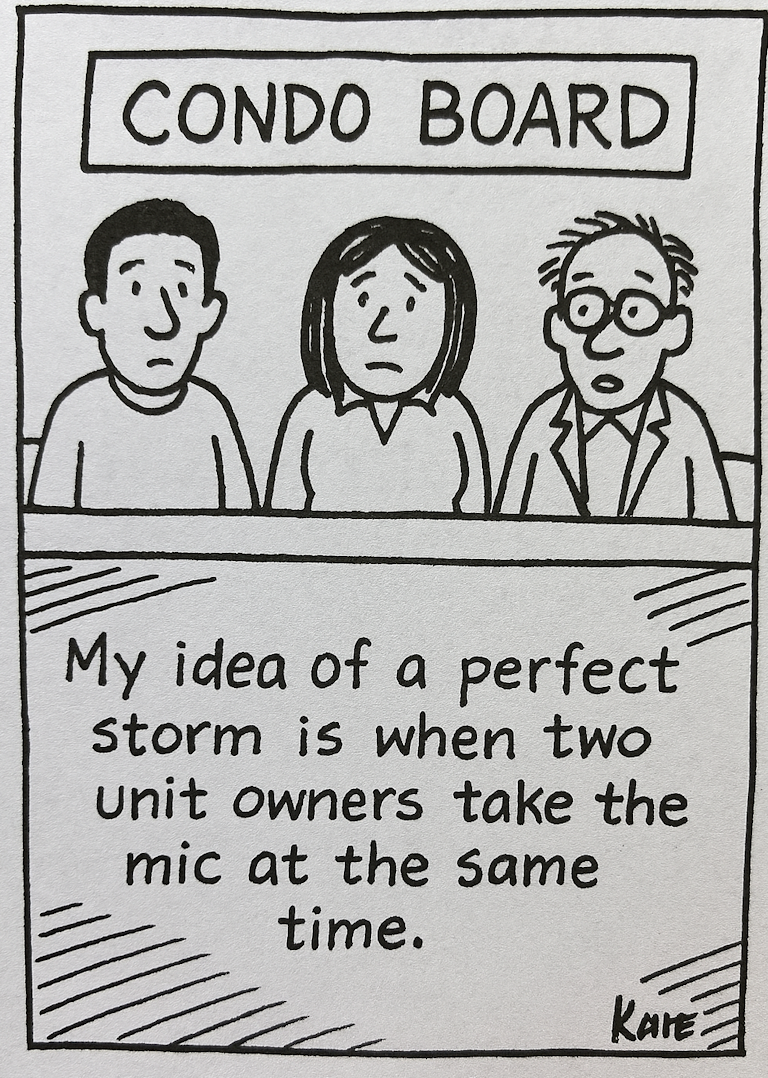
For fun:
.o0o.


 Aquarius Condominium, Hollywood Florida - Not ACA site